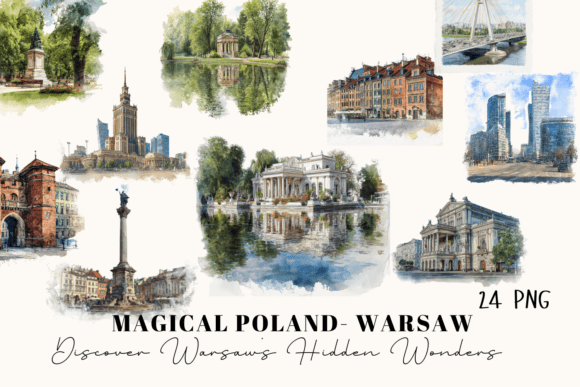
Watercolor Landmarks of Warsaw
Watercolor Landmarks of Warsaw – Poland is a curated collection of soft, luminous watercolor paintings that capture the city’s most iconic architecture, from the Royal Castle and the Barbican to the Palace of Culture and Science. Created by artists who specialize in loose, expressive watermedia, these works offer a fresh way to see Warsaw’s layered history—where Gothic spires meet socialist modernist blocks, and cobblestone lanes open onto vibrant riverbanks. The collection exists both as physical prints and as digital references, making it accessible for study, display, or creative reuse.
For anyone who has walked Warsaw’s Old Town or admired its skyline from the Vistula, these watercolors do more than document buildings. They convey atmosphere—the muted light of a winter afternoon, the green patina of a copper roof, the bustle of a market square softened into washes of color. That blend of accuracy and emotion is what draws different kinds of people to the same set of images, each for their own reasons.
Why Artists and Illustrators Turn to These Paintings
If you work with watercolor or teach it, you know how difficult it is to balance architectural precision with the medium’s natural fluidity. Straight lines and rigid perspective can fight against watercolor’s wet-on-wet effects. The Watercolor Landmarks of Warsaw collection demonstrates how accomplished artists solve that tension. You can see how they let a wall bleed into shadow, how they suggest a window with a single stroke, and where they choose to add crisp detail—often only at focal points like a clock face or an arched doorway.
For beginners, studying these pieces is like having a masterclass in simplification. Instead of copying every brick, you learn to identify the essential shapes that make a landmark recognizable. A beginner might use a print as a reference and try to replicate the same loose approach, focusing on value blocks rather than outlines. Experienced illustrators, on the other hand, may critique the technique more closely—the choice of pigments, the handling of negative space, the balance between warm and cool tones. They might adapt the compositions for their own projects, perhaps restyling a landmark for a travel poster or a children’s book illustration.
Many working artists care deeply about long-term usefulness. A single strong reference can serve multiple projects: a blog post about Warsaw, a custom greeting card, a mural proposal, or even a tattoo design. The watercolor style also wears well over time—it never looks dated the way some digital art filters do. For creators who sell prints or licensing rights, having a distinctive hand-painted look can set their work apart in a crowded market.
Travelers, Bloggers, and Cultural Enthusiasts
Not everyone who loves Warsaw’s landmarks paints or draws. Travelers and bloggers may care about the Watercolor Landmarks collection for entirely different reasons. A travel writer preparing an article on Warsaw architecture might license an image that feels warmer and more evocative than a standard photograph. Blogger audiences respond to emotional resonance, and watercolors naturally convey a sense of place without looking like stock imagery.
Cultural enthusiasts who appreciate Poland’s heritage often seek out representations that go beyond tourist clichés. These watercolors show Warsaw not as a postcard-perfect city but as a living, textured place. The same painting that highlights the careful reconstruction of the Old Town might also capture a modern tram winding past a nineteenth-century tenement. That juxtaposition matters to people who want to understand the city’s narrative—how it was rebuilt after war, how it continues to evolve. For them, the value is cultural authenticity and emotional depth rather than technical execution.
If you are planning a trip to Warsaw, studying these watercolors can also function as a kind of pre-travel orientation. You begin to recognize landmarks by their silhouette, and when you later stand in front of them, the experience is layered. You remember the painting and notice details the artist chose to emphasize or omit. This deepens your connection to a place you might otherwise just photograph and move on from.
Educators and Students Across Disciplines
The Watercolor Landmarks of Warsaw – Poland collection is not just for art classrooms. History teachers can use the images to spark discussion about Polish architecture and urban planning. A single painting of the Warsaw Uprising Monument opens conversations about memory and public art. Geography instructors might use the Vistula riverfront scenes to talk about how waterways shape city development. The soft, accessible medium lowers the barrier for students who feel intimidated by formal architectural drawings, making the built environment feel approachable.
For language educators teaching Polish culture or Polish as a foreign language, visual aids like these support vocabulary building and cultural context. You can pair a watercolor of the Wilanów Palace with a reading passage about Baroque architecture, then ask students to describe what they see using target vocabulary. The emotional tone of the painting—serene, stately, or bustling—helps learners connect words to feelings.
Students themselves may find these artworks useful for presentations or research projects. A high school student preparing a project on Warsaw’s reconstruction after WWII could use the watercolors to illustrate both the historic and rebuilt city. A university student studying art history might analyze how contemporary watercolor artists interpret socialist modernist structures. In both cases, the collection offers ready-made visual material that is both beautiful and credible.
Small Business Owners and Marketers
Local business owners in Warsaw and beyond can leverage watercolor landmarks in packaging, branding, and interior decor. A café near the Old Town might hang prints on its walls, reinforcing a cozy, handcrafted aesthetic. A boutique hotel could commission placemats or postcards featuring the same series, giving guests a takeaway that feels personal. For marketers, the watercolor style often signals authenticity and care—qualities that appeal to customers tired of mass-produced visuals.
If you run an online shop selling Polish-themed goods, you might incorporate these watercolors into product designs. Tote bags, notebooks, phone cases, and tea towels gain a unique selling point when they carry artistic, location-specific imagery. The commercial value comes from differentiation: most souvenir shops use glossy photographs, so a watercolor print stands out on a shelf. You do not need to be an artist yourself; you simply need access to licensed artwork that resonates with your target audience.
Marketers planning a campaign around Warsaw heritage or Polish tourism can also use these images in social media posts, email newsletters, or blog headers. Watercolors tend to attract more engagement on visual platforms like Pinterest and Instagram because they feel less corporate. The soft edges and gentle colors encourage users to pause and look, which is exactly what you want when promoting a destination or a product.
Hobbyists and Casual Creatives
Perhaps you have never painted seriously, but you enjoy coloring, journaling, or collecting art. The Watercolor Landmarks of Warsaw – Poland collection can serve as inspiration for a travel journal you are building after a trip. You could print a small version and paste it next to your own notes, train tickets, and dried flowers. Or you might buy a full-size print to frame in your home office as a daily reminder of a city you love.
Hobbyists who do practice watercolor at home will find the landmarks approachable as painting references. You do not need to travel to Warsaw or even own a reference photo; the painting itself shows you how another artist interpreted the scene. Try painting your own version, using the same composition but swapping in colors that fit your available palette. This kind of study builds skill without pressure. You are not aiming for a perfect copy—you are practicing seeing, mixing, and trusting the brush.
For those who value ease of use and low cost as a starting point, digital downloads of these watercolors are often available at reasonable prices. You can print at home or use a local print shop without the expense of original artwork. That flexibility matters when you are exploring a new creative interest and do not want to invest heavily upfront.
How to Choose What Fits Your Needs
When evaluating whether Watercolor Landmarks of Warsaw – Poland matches your own goals, skill level, or project type, consider what you value most in visual content.
- If technical quality and learning value are your priorities, look for high-resolution images with clear visible brushwork. Study how the artist handles wet-on-dry edges versus wet-in-wet washes. The more detail you can see, the more you can learn.
- If emotional resonance and atmosphere matter more, focus on compositions that speak to you personally—a favorite view of the river, a quiet courtyard, a snowy market square. Trust your instinct about which pieces make you feel connected to the city.
- If commercial use is your goal, verify licensing terms. Some collections allow reuse in products and marketing, while others restrict reproduction. Always confirm before incorporating any image into goods or campaigns.
- If you are a beginner, select paintings with simpler compositions—a single building against a plain sky rather than a crowded square. You will find it easier to deconstruct the scene and practice your own version.
The Watercolor Landmarks of Warsaw – Poland collection sits at an intersection of art, history, and practical use. It serves the painter seeking technique, the traveler chasing memory, the teacher building curriculum, the business owner adding atmosphere, and the hobbyist discovering a new creative outlet. What makes it durable across those contexts is not just the quality of the paintings but the way they honor a city without being rigid or documentary. They leave room for personal interpretation, which is why the same image can look different to each person who encounters it.
Whether you are a creator, a professional, or simply someone who loves Poland’s capital, these watercolors offer a quiet invitation to see Warsaw again—softer, warmer, and full of light.